DDP shipping from China is a door-to-door freight service where one provider handles pickup in China, export clearance, ocean or air freight, destination customs clearance, duties and taxes, and final delivery to your address, FBA warehouse, or business. It works best for buyers who want a fixed landed cost from China to the USA, Canada, UK, or EU without managing customs themselves. The main pricing trap is treating a low ocean or air freight rate as a complete DDP quote — a properly scoped DDP shipping cost must also include duties, Section 301 tariffs where applicable, customs bond, brokerage, destination handling, and last-mile delivery.
1. What is DDP Shipping from China?
DDP (Delivered Duty Paid) is a premium shipping method where the seller or a licensed China freight forwarder takes full responsibility for the entire shipping process from China to the buyer’s destination. Our goal is to provide a predictable and streamlined door-to-door logistics solution. Under DDP terms, the buyer only pays one all-inclusive price, and the seller manages:
- Inland transportation in China.
- Export customs clearance.
- International air, sea, or rail freight.
- Import customs clearance at the destination country.
- Payment of all duties, taxes, and fees.
- Final door-to-door delivery.
Under the ICC Incoterms® 2020 rules, DDP places import clearance and applicable duty/tax responsibility on the seller, while the buyer is typically responsible for unloading at the agreed destination.
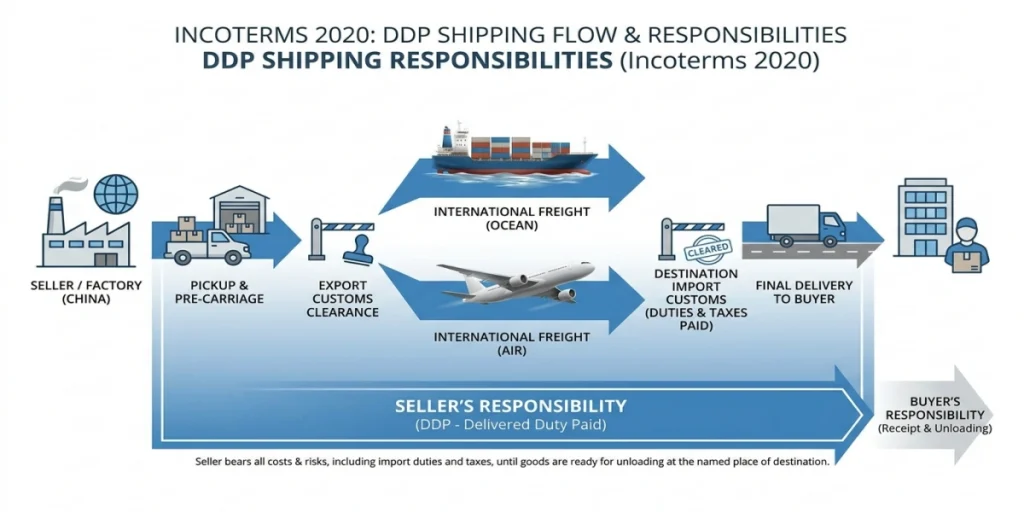
Division of Responsibilities under Incoterms® 2020
To ensure full transparency, the typical division of responsibilities under DDP terms is as follows. Final responsibility should still be confirmed in the sales contract and written freight quote, especially for unloading, special permits, customs exams, storage, and failed-delivery fees.
The Seller’s Responsibilities:
- All Costs: Covering all expenses until the goods are delivered, including transport, insurance, export/import duties, and taxes.
- All Risks: Bearing all risks of loss or damage to the goods until they have been delivered to the buyer’s named destination.
- All Documentation: Handling all export and import documentation, including commercial invoices, packing lists, transport documents, and customs entry forms.
- Customs Formalities: Acting as the declarant for both export and import customs clearance.
The Buyer’s Responsibilities:
- Payment for Goods: Fulfilling the payment for the goods as stipulated in the sales contract.
- Receiving the Goods: Taking delivery of the goods at the agreed-upon destination.
- Unloading: Handling the unloading of the goods from the arriving transport vehicle (unless otherwise agreed).
2. Required Documents & Information for DDP
To initiate a DDP shipment, the following documents and information are essential for ensuring a smooth process from booking to final delivery:
- Commercial Invoice: This is the primary document for customs. It must clearly state the shipper, consignee, detailed product descriptions, quantity, and the unit and total value of the goods.
- Packing List: This document details the specifics of the shipment, including the weight, dimensions (length, width, height), and total number of cartons or pieces. It is crucial for booking freight space and planning last-mile delivery.
- Consignee’s Full Information: The complete name, address, and contact details (phone and email) of the final recipient are required for customs and delivery purposes.
- Product Details for HS Code Classification: To determine the correct import duty rate, clear information about the product’s material, function, and intended use is necessary for accurate HS Code classification.
3. When Should You Choose DDP?
DDP is the ideal solution under the following scenarios:
- For E-commerce Sellers (Amazon, Shopify, etc.): If you need goods delivered directly to an FBA warehouse or end customers without them being involved in customs clearance.
- For Startups and Small Businesses: If you do not have an Importer of Record (IOR) or the resources to manage complex international logistics and customs procedures.
- For Established Brands Seeking Efficiency: If your company, even with an import license, wishes to outsource logistics complexity to focus on core business activities like sales and marketing.
Note on IOR: Import clearance normally requires an Importer of Record or authorized party responsible for the customs entry, depending on the destination country, shipment structure, and broker arrangement. In many DDP shipments, your freight forwarder or their customs partner helps coordinate this on your behalf — but it should be confirmed before you book.
- For Budget Predictability: If you need greater landed-cost predictability and want duties, taxes, clearance, and delivery responsibilities clarified before the cargo moves.
- For High-Value or Time-Sensitive Shipments: If the priority is a seamless, well-coordinated delivery with fewer handoffs, making the slightly higher cost a worthwhile investment in peace of mind.
When DDP Shipping May Not Be the Best Option
DDP is convenient, but it is not the right fit for every shipment. You may want another Incoterms arrangement if:
- You already have your own customs broker and want full control over import records.
- Your company needs to act as the Importer of Record directly for tax, audit, or compliance reasons.
- Your goods are regulated, restricted, or require special import permits.
- You need formal tax reclaim documentation under your own importer account.
- You want to compare FOB shipping from China, DAP vs DDP, or port-to-port shipping with separate customs brokerage.
Quick DAP vs DDP Comparison
Use this quick comparison when deciding whether DDP is the right Incoterms arrangement for your shipment. This is not a full Incoterms guide; it focuses on the responsibility split buyers usually care about when comparing door-to-door quotes.
| Term | Who handles import clearance? | Who pays duties and taxes? | Best for |
|---|---|---|---|
| DDP | Seller / freight-provider side arranges import clearance | Seller / provider side includes duties and taxes in the agreed price | Buyers who want a clearer all-inclusive landed cost and less customs involvement |
| DAP | Buyer or buyer’s broker handles import clearance | Buyer pays duties and taxes after arrival | Buyers with their own broker, importer setup, or tax / compliance process |
4. Key 2025–2026 Policy Changes Affecting DDP from China
Three regulatory shifts in 2024–2025 have materially changed how DDP from China is priced and who carries import-side responsibility. Any quote that ignores them is out of date.
1. U.S. Section 321 de minimis exemption removed for China-origin goods
The $800 duty-free threshold no longer applies to shipments of Chinese origin entering the United States. Every parcel — including small DTC e-commerce orders that previously cleared duty-free — now requires a formal or informal entry and is subject to duty, Section 301 tariffs where applicable, MPF, and brokerage. Practical effect: low-CBM DDP air parcels to U.S. addresses are noticeably more expensive than they were in 2024, and any DDP quote built on “de minimis routing” should be treated as non-compliant.
2. Canada CARM R2 is live (effective May 13, 2024)
All commercial importers into Canada — including non-resident importers using a Canadian freight forwarder as IOR — must be registered on the CBSA Assessment and Revenue Management (CARM) portal and have RPP (Release Prior to Payment) financial security in place, either via their own bond or by leveraging their broker’s. DDP shipments to Canada cannot legally clear without this. If the buyer has not yet onboarded to CARM, the quote should flag a one-time CARM registration step and state whose RPP security is being used.
3. UK and EU import VAT under DDP is generally non-reclaimable by the buyer
Under DDP, the freight forwarder or its customs partner usually pays import VAT under its own EORI / VAT number, not the buyer’s. That means the buyer cannot recover that VAT on its own VAT return. For UK and EU buyers who need input-VAT recovery, DAP plus the buyer’s own EORI / VAT registration is almost always the right structure — not DDP. A trustworthy DDP quote into the UK or EU should state explicitly under which EORI the import is being filed, and whether a fiscal representation model is being used.
4. U.S. Section 301 tariff scope has expanded
2024–2025 updates raised Section 301 rates on EVs, lithium-ion batteries, semiconductors, solar cells, and certain steel and aluminum products from China. Confirm in writing whether Section 301 (and any anti-dumping / countervailing duties tied to your HS code) is included in the DDP all-in price, or quoted at cost as a separate pass-through line.
5. DDP Delivery Timeline: Where Delays Usually Happen
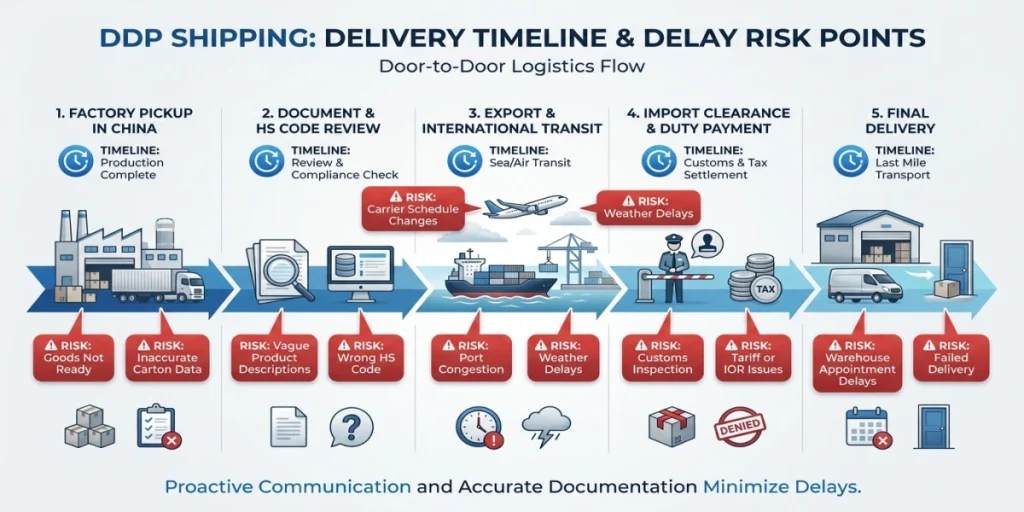
Instead of repeating general China shipping route tables, this DDP timeline focuses on the points that affect whether a door-to-door shipment stays truly all-inclusive and predictable.
| DDP Stage | What Can Delay It | How We Reduce the Risk |
|---|---|---|
| Supplier pickup in China | Goods not ready, inaccurate carton data, factory pickup restrictions | Confirm pickup address, carton count, gross weight, CBM, and loading access before dispatch |
| Document and HS code review | Vague product names, wrong declared value, missing material or usage details | Review invoice, packing list, product description, material, use, and HS code before booking |
| Export and international transit | Carrier schedule changes, capacity limits, customs inspection, port or airport congestion | Select a suitable air, sea, rail, or truck route based on cargo urgency, value, and destination |
| Import clearance and duty payment | IOR questions, tariff changes, customs exams, missing compliance documents | Clarify who handles import entry, duty payment, customs bond, and product-specific documents |
| Final delivery | Warehouse appointment rules, remote-area fees, failed delivery, unloading limits | Confirm delivery address, contact person, appointment requirements, and access limits in advance |
Timing note: Door-to-door timing still depends on the confirmed route and destination. For broader USA route and mode comparisons, keep those details in the dedicated China to USA shipping guide; this page should focus on DDP responsibility, quote scope, and risk control.
6. What’s Included in Your DDP Shipping Quote?
To provide full transparency, your DDP shipping quote is a comprehensive package. The table below shows the typical included items in an all-inclusive shipping from China price; the final scope should always be confirmed in writing based on your cargo, HS code, declared value, pickup address, destination, and delivery requirements.
| Cost Component | What It Covers |
|---|---|
| Original Local Charges | Trucking from supplier’s factory, commodity inspections, and port entry fees in China. |
| International Freight | The core cost of sea or air transportation from China to the destination country. |
| Destination Import Charges | All mandatory fees required to legally import your goods. This includes: ISF Filing, Customs Clearance & Brokerage, Customs Bond, and all Duties & Taxes. |
| Final Delivery Fee | The final trucking fee to deliver the goods from the destination port to your door or FBA warehouse. |
For USA ocean imports, the U.S. Customs and Border Protection Importer Security Filing “10+2” rule applies to cargo arriving by vessel and can lead to penalties, additional inspections, or delays if not handled correctly.
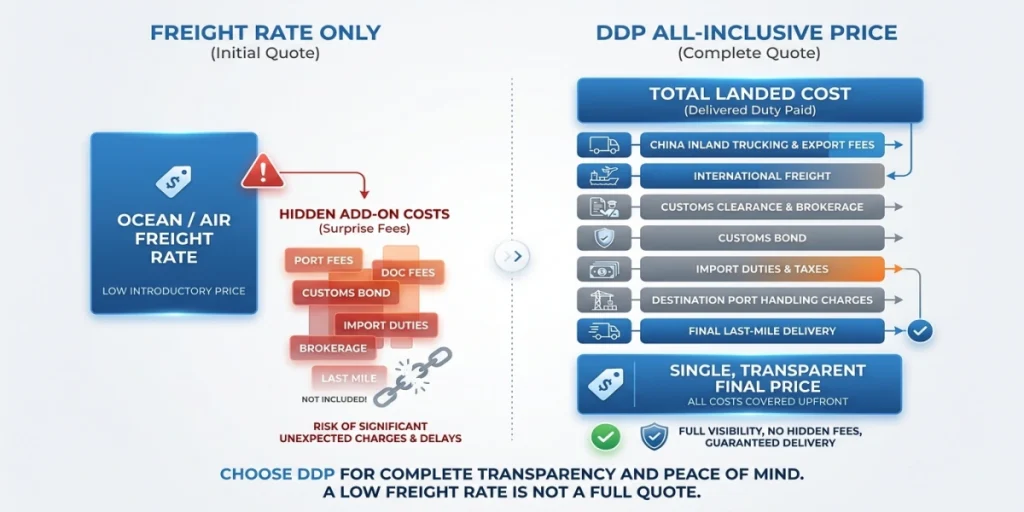
Freight Rate ≠ DDP Price: Don’t Be Misled by Low Quotes
One of the most common traps buyers fall into: mistaking a low ocean freight rate or air freight rate for a complete DDP price. They are not the same thing. A freight rate covers only the cost of moving cargo from port to port. A true DDP price must also include:
- China inland trucking & export fees
- ISF Filing
- Customs brokerage & clearance fees
- Customs bond
- Import duties & taxes, which vary by HS code, declared customsvalue, destination country, and applicable tariff programs
- Destination port handling charges (THC, PierPass, etc.)
- Last-mile delivery to your door or FBA warehouse
Some forwarders advertise an attractively low freight rate, only to add these costs later — after your cargo is already in transit and you have no leverage to walk away. This practice is sometimes called “low-ball quoting”.
What to ask before you commit: Request a full door-to-door cost breakdown, including all destination charges and an estimated duty amount based on your HS code and cargo value. A trustworthy DDP provider will give you this upfront — in writing.
How to Compare DDP Shipping Quotes
Before accepting a DDP quote, check whether every cost and responsibility is clearly included in writing.
| Quote Question | Why It Matters |
|---|---|
| Are duties and taxes included? | Prevents surprise landed costs after the cargo arrives. |
| Who acts as the Importer of Record? | Clarifies who is legally responsible for import clearance. |
| Is the HS code confirmed? | Helps avoid incorrect duty calculation or customs holds. |
| Is customs bond included? | Important for USA imports and customs entry processing. |
| Is final delivery included? | Confirms whether the price covers delivery to your door, warehouse, or FBA facility. |
| Is the quote written as all-inclusive? | Reduces the risk of later add-on charges. |
DDP Shipping Price Ranges (Industry Reference)
The ranges below are industry reference figures as of mid-2026, drawn from public market data — useful as a sanity check when comparing offers. Your actual DDP quote depends on cargo type, HS code, declared value, route, season, and current tariff conditions, and may sit outside these ranges.
| Mode | Typical Reference Range (USD) | Transit (Door-to-Door) | Best For |
|---|---|---|---|
| Air Express / Air Freight | ~$4–$8 per kg | ~5–12 days | Urgent, small, high-value cargo |
| LCL Ocean (Less than Container Load) | ~$80–$150 per CBM | ~25–45 days door-to-door | Small batches under ~15 CBM |
| FCL 20’/40′ Ocean | ~$2,000–$5,500 per container | ~20–35 days door-to-door | Full-container shipments, stable volume |
Tariff note: U.S. duties and trade measures for China-origin goods can vary by HS code, declared value, country of origin, and active tariff programs. A DDP quote should clearly state whether Section 301 duties and any other applicable import charges are included. Because tariff treatment can change, use the USTR Section 301 investigation page and your confirmed HS code to verify the duty basis before booking.
What an All-Inclusive DDP Price Is Actually Made Of
A real DDP quote is rarely “freight + duty.” A typical landed-cost breakdown looks like this:
| Cost Component | Typical Share of Total DDP Price |
|---|---|
| International freight (sea / air) | ~35–55% |
| Duties & taxes (including Section 301 where applicable) | ~10–30% |
| China origin charges (trucking, export, handling) | ~8–15% |
| Destination port charges & customs clearance | ~8–12% |
| Last-mile delivery (door / FBA / warehouse) | ~5–12% |
| Insurance (optional all-risk) | ~1–3% of cargo value |
Reference ranges only; the exact share depends on cargo density, HS code, route, and tariff conditions. Use this breakdown when comparing DDP offers — a properly scoped all-inclusive price should clearly account for every component above.
Comparing DDP quotes from China?
Send us your cargo type, CBM or weight, destination, and timeline. We will come back with a written all-inclusive breakdown — freight, duties, customs clearance, and last-mile delivery — so you can compare offers on equal footing.
7. How We Keep a DDP Shipment Truly Door-to-Door
A DDP shipment rarely fails because the freight moved from port A to port B. It fails because one responsibility was not clearly assigned before the cargo moved. The three checkpoints below are where most “all-inclusive” quotes silently break — and where we close the gap:
- Exception Pre-Flagging: Before the quote is sent, we identify line items that often fall outside routine DDP pricing — customs exams, port storage, failed delivery, remote-area surcharges, special permits, missing or incorrect documents — and price them explicitly or note them as pass-through, so post-arrival invoices don’t surprise the buyer.
- Last-Mile Readiness Check: We confirm final address access, unloading method (live-unload vs drop-trailer), warehouse appointment windows, FBA / fulfillment-center carton and label rules, and chassis / waiting / storage rate cards — the four accessorials that turn most “all-in” quotes into ~10% post-delivery overruns.
- Country-Specific Compliance Stack: Before booking, we confirm the import-side stack for your destination — ISF + customs bond for U.S. ocean, CARM RPP for Canada, EORI + VAT model for UK / EU — and clarify in writing whose name appears on the customs entry.
8. Basic Requirements for Door to Door Shipping from China
- “Made in China” Label: Every outer carton should have a clearly printed country-of-origin mark, such as “Made in China” where required by destination customs rules.
- Weight Limits: 30 kg (66 lbs) per carton is a handling rule of thumb, not a universal DDP requirement. It applies primarily to air express DDP, where airline ground crews enforce single-piece limits. Ocean LCL and FCL DDP routinely accept heavier cartons, but anything over 30 kg should be palletized and clearly marked. Confirm destination-warehouse limits separately — Amazon FBA, for example, caps individual cartons at 22.7 kg (50 lbs), and 63.5 kg (140 lbs) only when team-lift labeled or palletized.
- Compliance Restrictions: We do not carry prohibited items or counterfeit goods.
9. Value-Added Services
Our value-added services are designed to enhance your DDP shipment from China.
- Cargo Insurance: DDP clarifies who handles freight, clearance, duties, taxes, and delivery, but cargo insurance is not always automatically included. For high-value, fragile, or time-sensitive cargo, confirm whether all-risk insurance is included in the written DDP quote or offered as an optional add-on.
- Quality Inspection: We can verify packaging and take photos before the goods leave our warehouse.
How My Everocean Handles DDP Shipments Differently
Our DDP service is built for buyers who need predictable landed costs, clear responsibility, and fewer handoffs between suppliers, brokers, carriers, and local delivery providers.
- Written all-inclusive quote: We clarify what is included before the shipment moves.
- HS code and duty review: We check product details upfront to reduce customs and duty surprises.
- Door-to-door coordination: We manage supplier pickup, export, freight, import clearance, and final delivery.
- USA, Canada, and UK lane experience: We match the shipping method to the destination, cargo type, and timeline.
- FBA and warehouse delivery support: We can coordinate delivery requirements for Amazon FBA, fulfillment centers, and business warehouses.
Get a DDP Shipping Quote from China
To prepare an accurate door-to-door quote, send us the key shipment details before booking. This helps us review the route, cargo type, HS code, duty estimate, delivery method, and final destination before your cargo moves.
| Information to Prepare | Why We Need It |
|---|---|
| Product name, material, and use | Helps with HS code classification and duty estimation. |
| Cargo value and commercial invoice | Needed for customs declaration and landed-cost calculation. |
| Carton quantity, weight, and CBM | Used to choose the right air, sea, LCL, FCL, or special cargo option. |
| Pickup address in China | Allows us to include origin trucking and export handling. |
| Final delivery address | Confirms last-mile delivery cost, warehouse access, and appointment needs. |
| Required delivery timeline | Helps us compare standard, fast ship, air, or time-sensitive options. |
Comparing DDP quotes from China?
Send us your cargo type, CBM or weight, destination, and timeline. We will come back with a written all-inclusive breakdown — freight, duties, customs clearance, and last-mile delivery — so you can compare offers on equal footing.
10. Real-World Case Studies: DDP Shipping in Action
To help you understand how our DDP service works in practice, here are three anonymized My Everocean case examples covering different cargo types and logistical challenges. They are provided as operational examples rather than guaranteed pricing, duty, or delivery outcomes; exact requirements depend on the confirmed HS code, cargo value, route, customs review, and final delivery conditions.
Case 1: Outdoor Furniture (Concrete-Top Tables + Seating) — Ningbo to Florida, USA
- Product: Outdoor furniture set (concrete-top tables + seating frames)
- Route: Ningbo → Florida, USA (Southeast region)
- Mode: LCL Ocean Freight
- Transit: ~50–60 days door-to-door
- Total DDP All-In Cost: ~USD 3,000 (door-to-door reference figure from an actual completed My Everocean shipment; varies by CBM, value, and current tariff conditions)
This shipment involved two product components classified under different HS codes — one for the concrete/cement elements, one for the seating frames — each carrying distinct duty rates under Section 301 tariffs. Accurate dual-classification was essential to avoid customs holds.
What the DDP quote covered:
| Category | Line Items |
|---|---|
| China Local Charges | Factory pickup (to Ningbo warehouse) + Commodity Inspection |
| Ocean Freight | LCL rate × actual CBM |
| USA Import Charges | ISF Filing + Customs Clearance + Duty & Tax (both HS codes) |
| Final Delivery | Door delivery to Southeast USA (Florida) |
Key takeaway: Mixed-material outdoor furniture (concrete + metal frame) triggers multi-HS-code classification. Misclassifying the concrete component would have meant the wrong duty rate under Section 301, a customs hold, and a post-arrival reclassification fee. Catching it during DDP quote review meant one coordinated plan — dual classification, duty calculation, customs clearance, and final delivery — with no surprise charges at the door.
Case 2: Automotive Tires (FCL 20GP, Single HS Heading) — Qingdao to Ontario, Canada
- Product: New pneumatic rubber tires for motor cars (HS 4011 heading)
- Route: Qingdao → Greater Toronto Area, Ontario, Canada
- Mode: FCL 20GP Ocean Freight + inland trucking
- Transit: ~28–35 days door-to-door
- Total DDP All-In Cost: ~USD 5,300 (door-to-door reference figure from an actual completed My Everocean shipment; varies by container utilization, declared value, and current tariff conditions)
A clean single-product FCL — tires under one HS heading, one 20GP container, one delivery address. The pricing risk on this kind of shipment is rarely customs; it concentrates in the accessorials at final delivery: chassis days, driver waiting time, live-unload hours, prepull, and yard storage — which is exactly where loosely scoped DDP quotes turn into surprise invoices after the cargo arrives.
What the DDP quote covered:
| Category | Line Items |
|---|---|
| Basic Ocean Freight | 20GP ocean freight + Destination DO Fee |
| Canada Import Charges | Import security filing + Handling Fee + Customs Clearance + EMF (Emergency Mitigation Fee — distinct from the carrier’s BAF / Bunker Adjustment Factor, which is the fuel surcharge and should be listed separately when applicable) + Duty (at cost, based on declared value and HS rate) |
| Final Delivery Fee | Canada trucking to the Greater Toronto Area — including 3 free chassis days (then $45/day); 2 hr free driver waiting (then $100/hr after); 2 hr free live-unload (then $100/hr after); Prepull $150 and Yard Storage $50/day available if needed |
Key takeaway: Single-product FCL DDP quotes look simple, but the gap between a clean delivery and a $500+ surprise invoice usually lives in what’s spelled out at the consignee’s door — chassis allowance, waiting and unload thresholds, prepull, and yard storage. A trustworthy DDP quote lists those rates upfront rather than tucking them into a vague “miscellaneous accessorials” line.
What happens if those thresholds are not written into the DDP quote
Using the same trucking schedule from this shipment, here is how quickly an “all-inclusive” quote can break down when the buyer didn’t lock the accessorial rates upfront:
- Chassis held 5 extra days at the warehouse (consignee’s appointment slipped): 5 × $45 = $225
- Driver waited 2 extra hours past the free window: 2 × $100 = $200
- Live-unload ran 1 hour past the free window: 1 × $100 = $100
Three very normal warehouse delays = ~$525 of post-delivery invoices on top of the ~USD 5,300 “all-in” price — almost 10% of the total quote, billed after the cargo is already unloaded and the buyer has no leverage. None of these line items are unusual; they are the default fallback rates the trucker will charge whenever the DDP quote stays silent on chassis days, waiting time, and unload windows.
Result: The buyer received a fixed door-to-door price with every accessorial threshold written into the quote — so a tight unload window or chassis extension was known and budgeted, not invoiced after delivery.
Case 3: Office Furniture (MDF, FCL 40HQ) — Shenzhen to Greater Toronto Area, Canada
- Product: Office furniture made of wood (MDF / medium-density fiberboard), HS 9403.30.0090
- Route: Shenzhen → Greater Toronto Area, Ontario, Canada
- Buyer profile: Ontario-based B2B office-furniture distributor restocking showroom and project inventory
- Mode: FCL 40HQ Ocean Freight + Canada trucking
- Transit: ~28–35 days door-to-door
- Total DDP All-In Cost: high four-figure USD range, all-inclusive door-to-door (reference figure from an actual completed My Everocean shipment; the exact number varies by container utilization, declared customs value, and current tariff conditions)
A single-importer 40HQ — one HS heading, one delivery address in the Greater Toronto Area. The pricing risk on a Canada-bound DDP shipment like this concentrates in two places: (1) the import-side compliance stack — eManifest filing, customs clearance, and CARM registration if the importer has not yet onboarded to the CBSA Assessment and Revenue Management portal — and (2) the last-mile accessorials at the consignee’s door (chassis days, driver waiting, live-unload hours, prepull, and yard storage). Both are common places where loosely scoped Canada DDP quotes turn into surprise invoices after arrival.
Tariff note: Under Canada’s MFN tariff schedule, HS 9403.30 (wooden office furniture) typically lands at a free duty rate, which means the “tax” actually paid on this lane is mostly GST (5%) charged on the duty-paid customs value — not duty itself. A DDP quote that lumps “duty + GST” together without clarifying this can look more expensive than it really is; we break the two out so the buyer can see exactly what is being paid for.
What the DDP quote covered:
| Category | Line Items |
|---|---|
| Basic Ocean Freight | 40HQ ocean freight + Destination DO Fee |
| Canada Import Charges | eManifest filing + Handling Fee + Customs Clearance + CARM Registration Fee (if needed) + Duty (at cost; HS 9403.30 typically MFN duty-free) + GST 5% on duty-paid customs value |
| Final Delivery Fee | Canada trucking to the Greater Toronto Area — including 3 free chassis days (then $45/day); 2 hr free driver waiting (then $100/hr after); 2 hr free live-unload (then $100/hr after); Prepull $150 and Yard Storage $60/day available if needed |
Key takeaway: For wood-based office furniture into Canada, two factors decide whether the DDP price stays clean: a correctly confirmed HS classification (MDF furniture under 9403.30 sets the duty rate and GST base — often duty-free under MFN, with GST 5% being the real tax line) and a written rate card for last-mile accessorials. If the importer has not yet registered on CARM, that step should be flagged in the quote upfront — not added as a surprise line item after the container has already landed in Ontario.
Result: The Ontario distributor received a fixed door-to-door price with the Canada import compliance stack (eManifest, customs clearance, CARM registration, duty, GST) and every last-mile accessorial threshold written into the quote before the 40HQ left Shenzhen.
FAQ
Why is one DDP quote much cheaper than another?
A very low quote may only cover the freight rate, not the full door-to-door cost. Before booking, confirm whether China pickup, export fees, ISF filing, customs brokerage, customs bond, duties, taxes, destination charges, and final delivery are all included in writing.
Will I pay anything extra after the shipment arrives?
In a properly scoped DDP quote, routine customs clearance, duties, taxes, and last-mile delivery are included upfront. Extra charges may still apply if the cargo details are inaccurate, customs exams occur, delivery fails, storage is incurred, special permits are needed, or the final address changes.
Can I use DDP if I do not have a customs broker or Importer of Record?
Often, yes. DDP is commonly chosen by buyers who do not want to manage import clearance themselves. Import clearance still requires an Importer of Record or authorized party, so confirm before booking who will handle the customs entry and what buyer information is required.
Is DDP suitable for Amazon FBA or warehouse delivery?
Yes. DDP can work well for Amazon FBA, fulfillment centers, and business warehouses when customs clearance, duty payment, and final delivery are coordinated in one plan. Confirm FBA labels, carton rules, delivery appointments, and warehouse address details before shipping.
How do tariffs affect DDP pricing from China?
Tariffs can change the final DDP price because duties depend on the confirmed HS code, declared customs value, country of origin, and active trade measures. A written DDP quote should state which duties and import charges are included instead of using a vague “all-in” label.
What should I confirm in writing before accepting a DDP quote?
Confirm the declared customs value and HS code that will appear on the entry, who will act as the Importer of Record, which duties or taxes are included, and whether destination port handling, customs clearance, and final delivery are part of the all-in price.
Is there a minimum order size for DDP shipping from China?
No fixed minimum. DDP works for parcel-level air shipments, small LCL batches, full containers, and oversized cargo alike. What changes by size is the most cost-effective mode — air for urgent small shipments, LCL for small batches, FCL for stable container volume, and special equipment for oversized cargo.