Whether you’re a first-time importer or an experienced buyer comparing freight options, shipping goods from China to the United States involves multiple moving parts — carriers, customs, tariffs, and paperwork. Most shipments are handled through a freight forwarder who coordinates export clearance, international transport, and import customs on your behalf.
This guide covers every shipping method available in 2026 — ocean freight, air freight, express courier, and DDP (door-to-door) — with real cost ranges, transit times, and actionable advice so you can make informed decisions and communicate confidently with your logistics partner.
2026 China–USA Shipping Market Update
Read our latest monthly report: China-USA Freight Market Update (Updated Monthly)
Because freight rates and tariffs remain volatile in 2026, importers should compare ocean, air, and DDP quotes based on their actual shipment details instead of relying on fixed online prices.
- Ocean rates: While significantly lower than the 2022 pandemic peak, base rates are subject to volatility from geopolitical events (e.g., Middle East tensions) which drive up fuel and insurance surcharges.
- Air freight: General rates fluctuate between $3.50–$6.00/kg depending on the season, with e-commerce volume and jet fuel prices being the primary drivers.
- Tariffs are in flux: Following early 2026 legal shifts (including the striking down of IEEPA-based tariffs and introduction of temporary Section 122 surcharges), the effective weighted tariff on Chinese goods hovers around 22%–35%. Always check the latest HS code rulings.
Quick Overview — Shipping Methods Compared
Not sure which method is right for your shipment? Here’s the short version:
| Method | Transit Time | Best For | You Handle Customs? |
|---|---|---|---|
| Ocean (FCL) | 15–35 days | Large volumes (15+ CBM) | Yes (or via broker) |
| Ocean (LCL) | 20–40 days | Small volumes (1–15 CBM) | Yes (or via broker) |
| Air Freight | 3–10 days | Time-sensitive, 45–500 kg | Yes (or via broker) |
| Express Courier | 1–5 days | Samples, <10 kg parcels | No (included) |
| DDP Door-to-Door | 12–40 days | Hassle-free, all-inclusive | No — all included |
DDP Door-to-Door Shipping from China to USA
What Is DDP (Delivered Duty Paid)?
DDP is an Incoterms trade term meaning the seller (or freight forwarder) handles everything — origin pickup, export customs, international transport, import customs, duty payment, and final delivery. As the buyer, you simply wait for your goods to arrive.
A typical DDP quote from China to the USA includes:
- Domestic pickup & warehouse handling in China
- International ocean or air freight
- US customs clearance & brokerage fees
- Import duties & taxes
- Last-mile delivery (UPS/FedEx nationwide)
- Cargo insurance (optional)
DDP pricing cannot be standardized into a fixed rate table — it varies by cargo type, weight, commodity HS code, applicable tariff rate, and current fuel surcharges. Always request a quote with your specific shipment details.
DDP Air Freight — Transit Time & Use Cases
- Transit time: 7–9 business days to US warehouse pickup + 3–5 days last-mile delivery via UPS/FedEx
- Route: Mainland China → US West/Central hub → nationwide distribution
- Best for: High-value goods, urgent restocking, e-commerce sellers needing fast turnaround
DDP Ocean Freight — Transit Time & Use Cases
- Standard ocean (OA service): 16–20 days port-to-port + 3–5 business days UPS/FedEx pickup + 3–5 days last-mile
- Matson express ocean: 11 days port-to-port + 3–5 days pickup + 3–5 days last-mile
- Best for: Large-volume, cost-sensitive shipments where 3–5 weeks of transit is acceptable
- Coverage: All 50 US states
- Minimum: 21 kg
Ocean Freight from China to USA: Costs & Transit Times
Rate Disclaimer: Freight rates change daily based on tariff policies, peak season demand, carrier capacity adjustments, and port congestion. All rates shown below are reference ranges only — actual pricing must be confirmed with your freight forwarder on the day of inquiry.
Why Do China–USA Shipping Rates Fluctuate So Much?
If you’ve searched for shipping rates online and found wildly different numbers, you’re not alone. Here’s why:
- Tariff policy shifts — e.g., the 2025 tariff pause triggered a “rush to ship” wave, with Gulf Coast rates spiking from $3,000 to $6,000–$8,000 per container overnight
- Peak season surges — Q4 Black Friday/Christmas prep and pre–Chinese New Year rushes tighten capacity and push rates up
- Blank sailings — carriers cancel scheduled voyages to manage supply, reducing available space
- Port congestion — LA/Long Beach backlogs generate extra surcharges and extend total transit time
- Layered surcharges — PSS, BAF, and “premium space guarantee” fees stack on top of the base rate
Full Container Load (FCL)
Container Size Guide
| Container | Internal Dimensions (L×W×H) | Capacity (CBM) | Max Payload | Typical Use |
|---|---|---|---|---|
| 20′ Standard (20GP) | 5.9m × 2.35m × 2.39m | 33 CBM | 25,000 kg | Heavy goods, machinery, raw materials |
| 40′ Standard (40GP) | 12.03m × 2.35m × 2.39m | 67 CBM | 26,500 kg | General merchandise, furniture |
| 40′ High Cube (40HQ) | 12.03m × 2.35m × 2.69m | 76 CBM | 26,000 kg | Lightweight/bulky goods, garments, toys |
| 45′ High Cube (45HQ) | 13.56m × 2.35m × 2.69m | 86 CBM | 25,600 kg | Extra-large volume shipments |
FCL Reference Rates — China to USA (March 2026)
| Origin → Destination | 20GP | 40GP/40HQ |
|---|---|---|
| Shanghai → Los Angeles/Long Beach | From $1,800 | From $2,500 |
| Shanghai → New York/New Jersey | From $2,800 | From $3,500 |
| Shenzhen/Guangzhou → Los Angeles | From $1,800 | From $2,500 |
| Shenzhen → New York/Savannah | From $2,800 | From $3,600 |
| Ningbo → Los Angeles/Seattle | From $1,850 | From $2,550 |
| Shanghai/Shenzhen → Houston | From $3,000 | From $3,800 |
Rates are base ocean freight only. Surcharges (BAF, THC, ISF, etc.) are additional. Source: industry average ranges compiled from BRF Logistics, FreightRight, and DocShipper, March 2026.
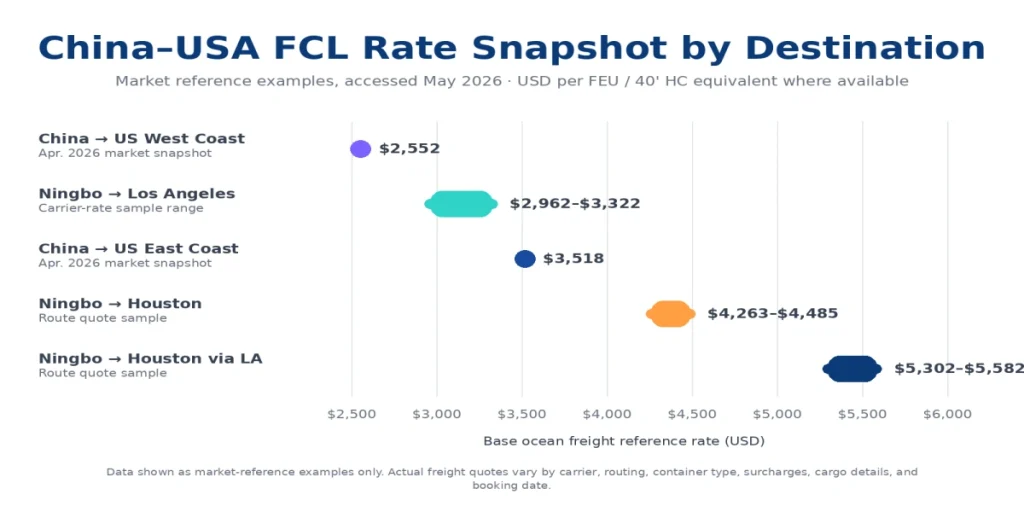
FCL rates vary significantly by destination, carrier, routing, and booking date. The figures shown are market-reference examples only; final quotes should be confirmed with shipment details before booking.
FCL Transit Times
| Route | Port-to-Port | Door-to-Door (est.) |
|---|---|---|
| China → US West Coast (LA/LGB/SEA) | 11–15 days | 18–30 days |
| China → US East Coast (NYC/SAV) | 25–35 days | 30–42 days |
| China → US Gulf Coast (HOU) | 28–38 days | 33–45 days |
Fastest option: Matson express service from Shanghai to LA — 11 days port-to-port.
Less than Container Load (LCL)
When to Use LCL
LCL is ideal when your cargo is 1–15 CBM — too much for air freight, too little to fill a container. Your goods are consolidated with other shippers’ cargo in a shared container.
- Good for: Small/medium importers, mixed SKU orders, first trial orders
- Not ideal for: Time-sensitive shipments (LCL takes longer due to consolidation/deconsolidation)
LCL Reference Rates — China to USA (March 2026)
| Route | Rate per CBM | Min. Charge |
|---|---|---|
| Shanghai → Los Angeles | From $370/CBM | 1 CBM |
| Shanghai → New York | From $440/CBM | 1 CBM |
| Shenzhen → Los Angeles | From $370/CBM | 1 CBM |
| Shenzhen → New York | From $440/CBM | 1 CBM |
| Ningbo → Los Angeles | From $345/CBM | 1 CBM |
LCL rates exclude destination charges (CFS fee, chassis fee, etc.). Actual total cost is typically 30–50% higher than the base ocean rate. Beware of ultra-low LCL base rates, as they often hide massive destination CFS charges.
LCL Transit Times
| Service Tier | West Coast | East Coast |
|---|---|---|
| Express LCL | 18–22 days | 28–32 days |
| Standard LCL | 22–30 days | 32–40 days |
Popular Sea Routes & US Ports
West Coast (fastest, cheapest ocean option):
- Los Angeles / Long Beach (LA/LGB) — America’s busiest port complex, handles ~40% of US-China ocean trade
- Seattle / Tacoma — closer to the Pacific Northwest and Midwest via rail
East Coast (closer to East Coast consumers):
- New York / New Jersey — largest East Coast port, serves the Northeast corridor
- Savannah (SAV) — fast-growing, lower congestion, ideal for Southeast distribution
- Charleston — alternative to Savannah
Gulf Coast:
- Houston — serves Texas and the South-Central US; fewer direct services, longer transit, but less congestion
Pro tip: Choose the port closest to your warehouse or final customer. Inland trucking from the wrong coast can add $1,000–$3,000+ and 5–7 extra days.
Air Freight from China to USA: Costs & Transit Times
Air Freight Rates — China to USA (March 2026)
As of March 2026, China-to-USA air freight rates generally start from $8.50/kg (all-in, including fuel surcharge), depending on shipment weight, cargo type, and airline.
The general rule: the heavier your shipment, the lower the per-kg rate. E-commerce and lightweight goods typically cost 10–20% more than general cargo due to dimensional weight pricing.
Sources: FreightRight TFX Update wk. March 2, 2026; WeFreight Feb 2026 market report. Rates change daily — always confirm with your freight forwarder.
Air Freight Transit Times
| Route | Airport-to-Airport | Door-to-Door (est.) |
|---|---|---|
| Shenzhen (SZX) → Los Angeles (LAX) | 1–2 days | 3–7 days |
| Shanghai (PVG) → Los Angeles (LAX) | 1–2 days | 3–7 days |
| Shanghai (PVG) → New York (JFK) | 1–3 days | 4–8 days |
| Guangzhou (CAN) → Chicago (ORD) | 1–3 days | 4–8 days |
| Hong Kong (HKG) → Los Angeles (LAX) | 1–2 days | 3–6 days |
Major Airlines on China–USA Routes
Most freight forwarders work with major carriers on the transpacific lanes, including:
- China Southern Airlines (CZ) — largest fleet in China, strong Guangzhou hub
- Air China Cargo (CA) — direct Beijing/Shanghai to LAX, JFK, ORD
- China Eastern Airlines (MU) — Shanghai Pudong hub, competitive rates
- Cathay Pacific Cargo (CX) — Hong Kong hub, premium service, accepts some DG
- Korean Air Cargo (KE) — via Seoul hub, good Midwest/East Coast connections
- EVA Air Cargo (BR) — via Taipei, reliable scheduling
- FedEx / UPS / DHL freighters — express air cargo with integrated last-mile delivery
- Cargolux (CV) — via Luxembourg hub, strong for European-routed cargo
When to Choose Air Freight
- Your deadline is under 2 weeks
- Goods are high-value and low-weight (electronics, samples, fashion)
- Shipment weighs 45–500 kg (heavier → consider ocean)
- You’re shipping lithium batteries (some carriers accept with proper DG documentation)
- Emergency restock — stockout is costing you more than the air freight premium
- Pre-production samples needed for approval before placing a bulk order
How to Choose the Best US Entry Airport
Choose the airport closest to your warehouse or distribution center to minimize domestic trucking costs:
- LAX — best for West Coast warehouses, Amazon FBA in California
- JFK/EWR — Northeast corridor, New York metro area
- ORD (Chicago) — Midwest hub, good for Central US distribution
- ATL (Atlanta) — Southeast US coverage
- DFW (Dallas) — South-Central US, Texas-based sellers
Express Courier from China to USA: Carriers & Rates
Courier Comparison
| Carrier | Transit Time | Lithium Battery? | Strength |
|---|---|---|---|
| DHL Express | 2–4 days | Yes (with DG docs) | Fastest to most US cities, excellent tracking |
| FedEx International | 2–5 days | Yes (with DG docs) | Strong US domestic network, good for rural areas |
| UPS Express | 2–5 days | Yes (with DG docs) | Reliable for heavy parcels, strong B2B service |
| SF Express | 3–7 days | Yes | Budget-friendly, strong China-side pickup network |
Express Courier Rates — China to USA (March 2026)
Retail rates for international express from China to the USA typically start from $30 for a 0.5 kg parcel (DHL/FedEx/UPS) and scale up with weight. SF Express is generally 20–30% cheaper than the Big 3 for the same weight bracket.
Freight forwarder rates are typically 30–50% lower than retail prices due to volume discounts. If you’re shipping regularly, always ask your forwarder for their courier rates rather than booking directly.
For exact pricing, check each carrier’s website or contact your freight forwarder for a competitive quote.
When to Use Express Courier
- Product samples (<5 kg) for buyer approval
- Urgent spare parts or replacement goods
- Documents and contracts
- E-commerce returns or small direct-to-consumer orders
- Lab testing samples
How to Choose the Right Shipping Method
By Speed — How Fast Do You Need It?
- Express courier — 1–5 days (fastest)
- Air freight — 3–10 days
- DDP air — 7–14 business days (including last-mile)
- Ocean (Matson express) — 18–25 days door-to-door
- Ocean (standard) — 25–45 days door-to-door (slowest)
By Budget — How Much Can You Spend?
- Ocean FCL — lowest per-unit cost for large volumes
- Ocean LCL — affordable for 1–15 CBM
- DDP ocean — moderate (all-in pricing, no surprises)
- Air freight — 3–5× more expensive than ocean
- Express courier — highest per-kg cost (best only for <10 kg)
By Convenience — Do You Want Hands-Off Shipping?
- DDP (Delivered Duty Paid) — fully managed, zero customs hassle → best for first-time importers or anyone who values simplicity
- Freight forwarder assisted (FOB/CIF) — you handle some paperwork, forwarder handles logistics
- Self-managed — you coordinate everything (only recommended for experienced importers)
By Cargo Type & Volume
- <10 kg → Express courier (DHL/FedEx/UPS)
- 10–150 kg → Air freight
- 150–500 kg → Air freight or DDP air
- 1–15 CBM → Ocean LCL
- 15+ CBM → Ocean FCL
- Any size + want zero hassle → DDP door-to-door
Full Comparison Table
| Criteria | Ocean FCL | Ocean LCL | Air Freight | Express | DDP |
|---|---|---|---|---|---|
| Transit time | 18–45 days | 22–40 days | 3–10 days | 1–5 days | 12–40 days |
| Cost level | Lowest | Low | High | Highest | Medium |
| Min. shipment | 1× 20GP | 1 CBM | 45 kg | 0.5 kg | 21 kg |
| Customs included? | × | × | × | √ | √ |
| Duties included? | × | × | × | Depends | √ |
| Best for | Bulk orders | Small batches | Urgent, high-value | Samples, docs | Hassle-free import |
| Complexity | High | Medium | Medium | Low | Lowest |
Common Surcharges & Hidden Fees Explained
One of the biggest complaints in international shipping is unexpected fees. Here’s a transparent list of surcharges you may encounter so nothing catches you off guard:
| Surcharge | Abbreviation | What It Is |
|---|---|---|
| Peak Season Surcharge | PSS | Carriers add this during high-demand periods (Aug–Nov, pre-CNY) |
| Bunker Adjustment Factor | BAF | Fuel surcharge — fluctuates with global oil prices |
| Port Congestion Surcharge | PCS | Extra charge when ports like LA/LB are backed up |
| Terminal Handling Charge | THC | Port terminal fees — charged at both origin and destination |
| ISF Filing Fee | ISF | Mandatory US security filing (Importer Security Filing 10+2) |
| Customs Brokerage Fee | — | Licensed customs broker fee for clearance processing |
| Demurrage & Detention | D&D | Late container return or delayed pickup penalties — per day |
| Space Guarantee / Roll-Over Fee | — | Premium charged during peak season to guarantee your container won’t be “rolled” (bumped) to the next vessel |
Tip: Always ask your forwarder for a fully itemized quote. Every surcharge should be listed line by line to avoid hidden fees.
How to Choose a Reliable China Freight Forwarder
Not all freight forwarders are equal. Here’s a quick checklist to evaluate before committing:
- Transparent pricing — Do they give itemized quotes or a vague lump-sum “all-in” price? Itemized is always better.
- Space guarantee rate — Can they secure vessel space during peak season? How often do they get “rolled” (container bumped to next sailing)?
- Proper documentation — Do they provide original Bill of Lading (B/L), commercial invoices, packing lists, and ISF filing?
- Communication & timezone coverage — Can they respond during US business hours? China–US time difference (12–16 hrs) is a real challenge.
- Verifiable track record — Do they have real customer reviews, case studies, or industry references you can check?
US Import Duties, Taxes & Customs Regulations (2026)
Current US–China Tariff Situation (March 2026)
The tariff landscape has shifted dramatically in early 2026. Here’s the current status:
Key events timeline:
- 2018–2024: Section 301 tariffs imposed on Chinese goods in multiple rounds (7.5%–25% across lists 1–4)
- 2025 Jan–Feb: IEEPA-based “reciprocal tariffs” added 20% + 10% fentanyl levy on all Chinese imports
- 2025 May 2: De minimis ($800 duty-free) exemption suspended for Chinese goods
- 2025 Aug 29: De minimis suspension expanded to all countries
- 2026 Feb 20: US Supreme Court strikes down IEEPA tariffs — ruling that IEEPA does not authorize the president to impose tariffs. All IEEPA-based tariffs voided.
- 2026 Feb 24: Section 122 emergency tariff — 15% temporary surcharge on all imports (150-day limit, expires ~July 2026)
- 2026 Mar 11: New Section 301 investigations launched against China, EU, and Mexico (overcapacity + forced labor concerns)
What Chinese goods currently face:
| Tariff Layer | Rate | Status |
|---|---|---|
| Section 301 (Lists 1–4) | 7.5%–25% | Active — covers 100% of Chinese goods |
| Section 232 (Steel & Aluminum) | 25% | Active — applies to all countries |
| Section 122 (Emergency) | 15% | Active — temporary 150 days, expires ~July 2026 |
| IEEPA Reciprocal Tariffs | 20% | Struck down by Supreme Court |
| IEEPA Fentanyl Tariffs | 10% | Struck down by Supreme Court |
Effective weighted tariff rate on Chinese goods: approximately 22%–35% (depending on product category and calculation method). China faces the highest tariff rate of any US trading partner.
Sources: PIIE Tariff Tracker (updated March 3, 2026); Reuters (March 11); Yale Budget Lab (Feb 21); Tax Foundation Tariff Tracker 2026.
How to Calculate Import Duties (4 Steps)
- Find your HS Code — Every product has a Harmonized System code. Check with your supplier or use the USITC HTS search tool.
- Look up the tariff rate — Search your HS code in the Harmonized Tariff Schedule to find the base duty rate + any additional Section 301/232 rates.
- Determine customs value — US Customs uses FOB value (cost of goods at the port of export) as the duty base. International shipping costs are generally NOT included.
- Calculate — Customs Value × (Base Duty Rate + Section 301 Rate + Section 122 Rate) = Total Duty Owed
Common misconception: Many importers mistakenly believe duties are calculated on the CIF value (including shipping and insurance). In the US, the dutiable value is the FOB transaction value — the price paid for the goods at the point of export.
Types of Import Taxes
- Customs Duty — Based on HS code and tariff schedule
- Section 301 Additional Duty — China-specific, 7.5%–25%
- Section 122 Surcharge — 15% temporary (all countries)
- Merchandise Processing Fee (MPF) — 0.3464% of cargo value (min $31.67, max $614.35)
- Harbor Maintenance Fee (HMF) — 0.125% of cargo value (ocean shipments only)
- State/local taxes — Some states charge additional fees on imports
De Minimis Exemption Update
The $800 de minimis exemption no longer applies to Chinese goods.
- Suspended for China/Hong Kong: May 2, 2025
- Expanded to all countries: August 29, 2025
- Continued under Feb 20, 2026 Executive Order
- Currently under judicial review
This means all shipments from China — regardless of value — are subject to duties, MPF, and formal customs entry. The era of duty-free small packages from China is over.
Customs Clearance Process
Required documents for US import clearance:
- Bill of Lading (B/L) or Air Waybill (AWB)
- Commercial Invoice — must include seller, buyer, product description, HS code, quantity, unit price, total value, Incoterms
- Packing List — detailed breakdown of cartons, weights, dimensions
- ISF 10+2 Filing — must be submitted to US Customs at least 24 hours before vessel departure (ocean only)
- Customs Entry (CBP Form 7501) — filed by your licensed customs broker
- FDA/FCC/CPSC certificates (if applicable) — for food, electronics, children’s products
Common mistakes to avoid:
- Missing “Made in China” labels → US Customs mandates that all products and master cartons be properly marked with their country of origin. Missing labels lead to severe delays, customs holds, and relabeling fines.
- Incorrect HS code → wrong duty rate or customs hold
- Under-declaring value → penalties, seizure, or blacklisting
- Late ISF filing → $5,000 penalty per violation
- Missing product certifications → shipment detained at port
Do You Need Cargo Insurance?
Yes, especially for shipments over $5,000.
Carrier liability is extremely limited — under the US Carriage of Goods by Sea Act (COGSA), ocean carriers cap their liability at $500 per customary freight unit (which is often interpreted as per pallet or package, NOT the whole container, but still a fraction of your cargo’s value). If your shipment is lost or damaged, relying on carrier liability is incredibly risky.
Cargo insurance typically costs 0.6%–1.0% of declared value — a small price for full protection. You can arrange this through your forwarder or a third-party insurer.
I’m trying to save money — is ocean freight always the cheapest way to ship from China to the USA?
Usually, yes. Ocean freight is the lowest-cost option for larger shipments. If your cargo is 15+ CBM, Full Container Load (FCL) usually gives the best per-unit cost. If your shipment is smaller, around 1–15 CBM, Less than Container Load (LCL) is usually more affordable than booking a full container. For urgent or lightweight cargo, air freight or express may still make sense, but the per-kg cost is higher.
My supplier says shipping will take “about a few weeks” — how much time should I really budget?
It depends on the method and destination. Express courier usually takes 1–5 days, air freight 3–10 days, ocean shipping to the US West Coast about 15–20 days port-to-port, and ocean shipping to the East Coast about 25–35 days port-to-port. Always add extra time for customs clearance, port handling, and final delivery. For DDP ocean door-to-door, a realistic planning range is usually about 25–40 days.
I got a container quote that looks cheap — what costs might be missing?
Many low container quotes only show the base ocean freight. You may still need to add surcharges such as THC, BAF, ISF filing, customs brokerage, destination handling, chassis fees, and possible demurrage or detention. As of March 2026, base FCL rates may start from around $1,800 for a 20-foot container and $2,500 for a 40-foot container, but the total landed cost is often higher.
My forwarder says “DDP includes everything” — what should I check before paying?
In a proper DDP arrangement, the quote should cover pickup in China, export customs, ocean or air transport, US import clearance, duty payment, and delivery to your door. Before paying, confirm whether duties, taxes, brokerage fees, last-mile delivery, remote-area surcharges, optional cargo insurance, and product-specific compliance costs are included. If the quote is vague, unusually cheap, or only described as “all-in” without a cost breakdown, ask for clarification.
Am I being overcharged for DDP shipping from China to the USA?
Not necessarily. DDP pricing cannot be standardized into one fixed table because it depends on cargo type, weight, HS code, applicable tariff rate, fuel surcharges, and final delivery requirements. Compare DDP air, DDP ocean, and standard air/ocean freight quotes using the same shipment details. A reliable quote should clearly state which duties, taxes, brokerage fees, and last-mile delivery costs are included.
Do I really need all these import documents, or can my freight forwarder handle them?
Your forwarder or customs broker can usually handle filing, but the shipment still needs the right documents. Expect to prepare a Bill of Lading or Air Waybill, Commercial Invoice, Packing List, and for ocean shipments, ISF 10+2 filing before departure. Some products also need FDA, FCC, CPSC, or other product-specific certificates.
How bad are US tariffs on Chinese goods in 2026?
As of March 2026, Chinese goods may face Section 301 tariffs of 7.5%–25%, a Section 122 emergency surcharge of 15%, and Section 232 duties of 25% on steel and aluminum. The effective weighted rate is approximately 22%–35%, depending on product category and HS code. Always check the latest tariff ruling before shipping.
Can I still use the $800 de minimis rule for small China shipments?
No. The $800 duty-free threshold for Chinese goods was suspended on May 2, 2025, and later expanded to all countries on August 29, 2025. Shipments from China now require formal customs entry and may be subject to duties regardless of value.
My shipment is too small for a full container but too big for courier — should I use LCL?
Probably. LCL is designed for shipments that do not fill a whole container, typically around 1–15 CBM. Your goods share container space with other shippers. It is cheaper than FCL for small batches, but usually takes 5–10 days longer because of consolidation and deconsolidation.
I’m running out of stock — should I pay for air freight or wait for ocean freight?
Choose air freight if your shipment is urgent, under a two-week deadline, high-value, or needed to prevent a costly stockout. Choose ocean freight if you can wait 3–5 weeks and cost savings matter more. A useful rule of thumb: if freight cost exceeds 15–20% of the goods’ value, consider switching methods or adjusting shipment size.
Are duties based on my product price only, or do they include shipping too?
For US imports, duties are generally calculated on the FOB value — the price of the goods at the port of export in China. International shipping and insurance are generally not included in the dutiable value. Always confirm that your commercial invoice uses the correct transaction value and Incoterms.
Why do different websites and forwarders give completely different China–USA shipping prices?
Freight rates change daily based on fuel, capacity, peak season demand, port congestion, carrier blank sailings, and surcharges. Some quotes only show base freight, while others include customs, duties, or last-mile delivery. The only reliable way to compare is to request quotes using the same shipment details: weight, volume, commodity type, HS code, origin, and destination.
What happens if my container gets “rolled” to the next vessel?
During peak season or capacity shortages, carriers may bump a booked container to a later sailing. This is called “rolling” or 甩柜. To reduce the risk, book 2–3 weeks in advance, use carriers with stronger schedule reliability, and consider a space guarantee if the timeline is critical. During peak periods, space guarantee fees can add $1,000–$2,000.
Is cargo insurance worth it, or is the carrier responsible if something goes wrong?
Cargo insurance is strongly recommended for high-value shipments. Under COGSA, ocean carriers often limit liability to $500 per customary freight unit, which may be far below your actual cargo value. Cargo insurance typically costs 0.6%–1.0% of declared value, which is usually a small premium compared with the risk of loss or damage.